
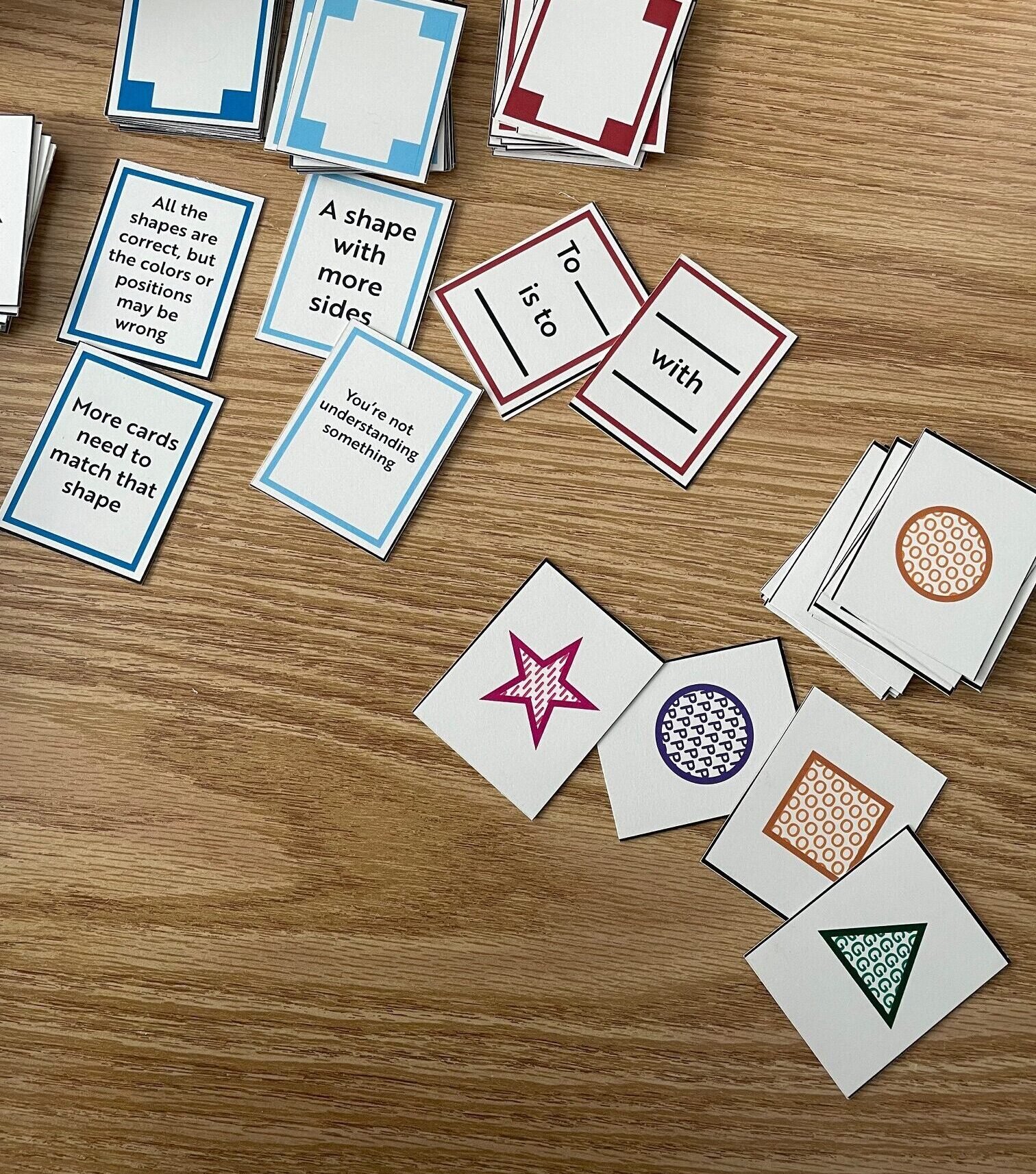

So, things have been pretty crazy recently, mostly because of my senior project as a graphic design major.
Over the past two semesters, I’ve developed a board game based on my research into language and idioms.
The project will be on display in Marion Art Gallery at SUNY Fredonia on May 2nd (come check it out), so on top of creating a game I also had to make it work as a display piece in the art gallery.
Altogether, it’s been a massive project, and I’ve learned a ton along the way.
Initially my project started off as research into idioms, as well as other linguistic elements, such as slang terms and onomatopoeias. I also decided early on that my project will be presented through interactive design, engaging beyond just visual presentation.
Further research led me to think about a few different project directions. Unintentionally, most of my ideas came as board game ideas.
Researching idiom comprehension inspired several ideas for how idioms could work in a game. For example, players could modify idioms by shortening them or changing their structure and the team would guess its meaning, utilizing the flexibility of language comprehension.
I decided to design an easy, low level board game, and began sketching ideas based on this concept. With my background of playing lots of different board games, I found it easy to take mechanics I was familiar with and combine them with my own concepts.
As I wrote down ideas, I referenced specific games that inspired the gameplay. Eventually I came up with a collaborative puzzle game, using limited speech, with mechanics inspired by Decorum, Codenames, and The Mind.
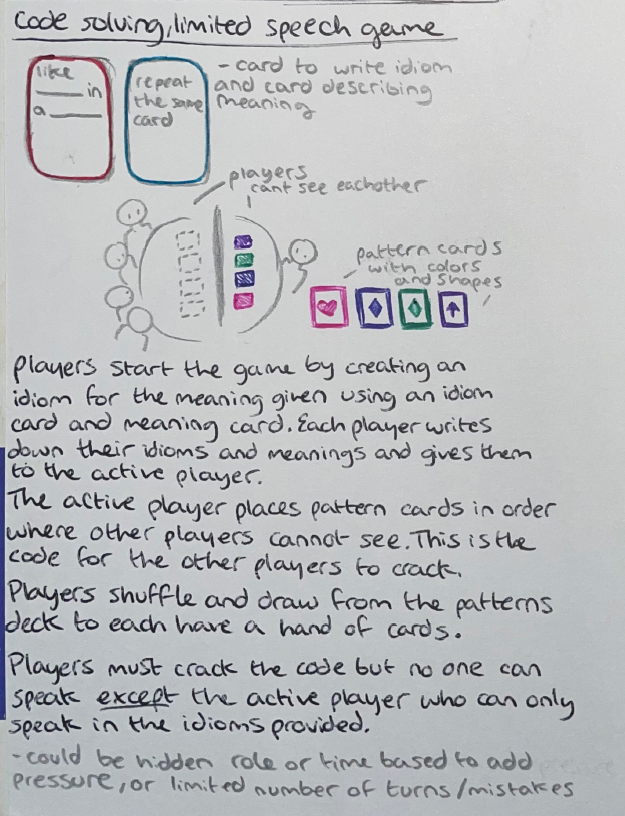
From here I created a dummy to playtest with. The biggest thing when creating a board game is playtesting, and I saw this firsthand.
Plenty of game elements were only realized as successful or not, through testing.
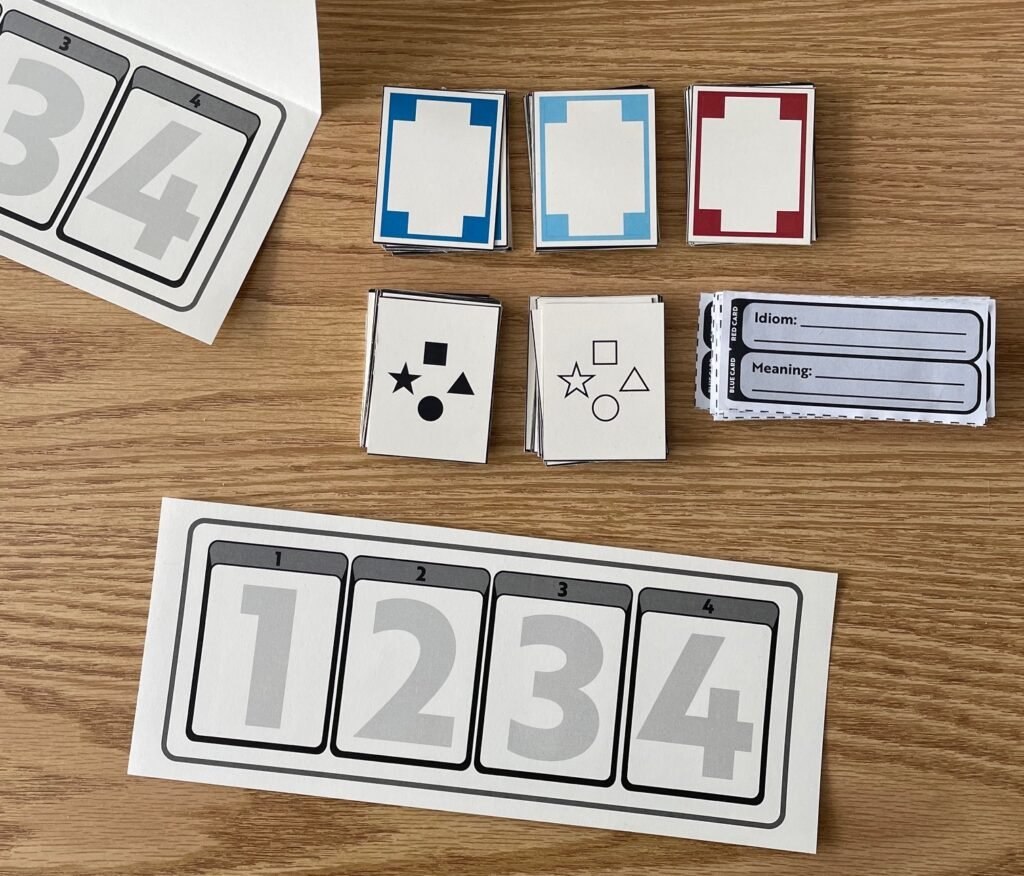
Each playtest I also kept notes detailing the players, roles, gameplay, and feedback with what I needed to fix before playing again. I made sure to do this every time, even if it was just a messy recollection on my notes app, it was imperative to improve the game, and every player brought new perspectives.
This process allowed me to get a working game before any design, theme, or name. I was so focused on making it work that for the longest time there was no name, or I just called it “idioms” or “the idiom game”.
I’m happy with this process though, working closely on the user experience and interactivity of my project, before forcing a theme on it. I wanted that part to come later and fit the gameplay.
So how is the game played?
The game starts with choosing players. One player is the active player, and the rest are team players.
During the first phase, each team player creates an idiom-like code phrase, using prompts from cards.
Each phrase associates with a secret meaning that relates to the game (like “wrong color” or “correct shape”). These phrases are kept secret from other players, except the active player, who gets a copy of all phrases.
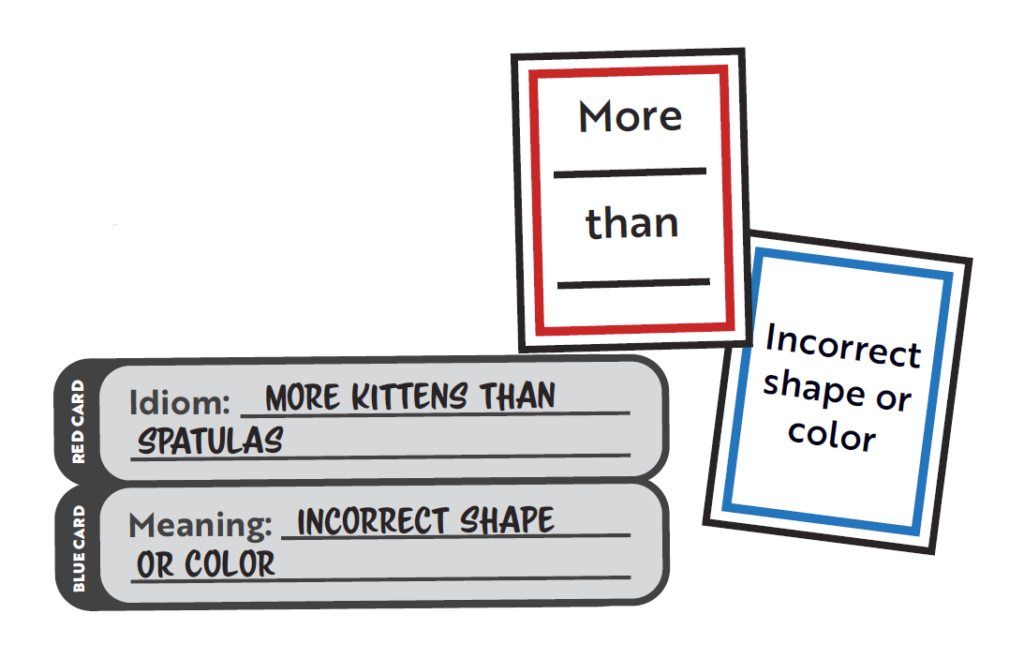
Next, shape cards are dealt out evenly to all team players. These cards vary between 4 different shapes and colors.
From a separate shape card deck, the active player secretly draws four shape cards to create the target sequence.
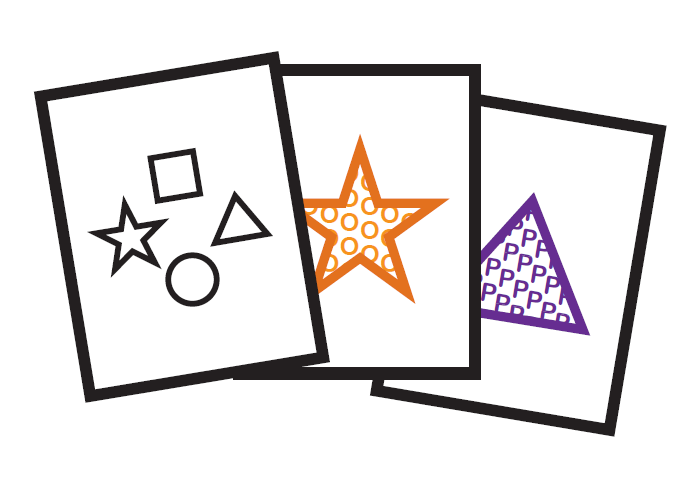
During the game, team players take turns placing cards on the numbered board to try and correctly guess the sequence.
The active player gives clues only by speaking in the idioms created earlier, using them to hint whether cards are correct or need to be changed, but they can’t explain further or use any other gestures.
Team players on the other hand can’t speak at all but can use nonverbal communication.
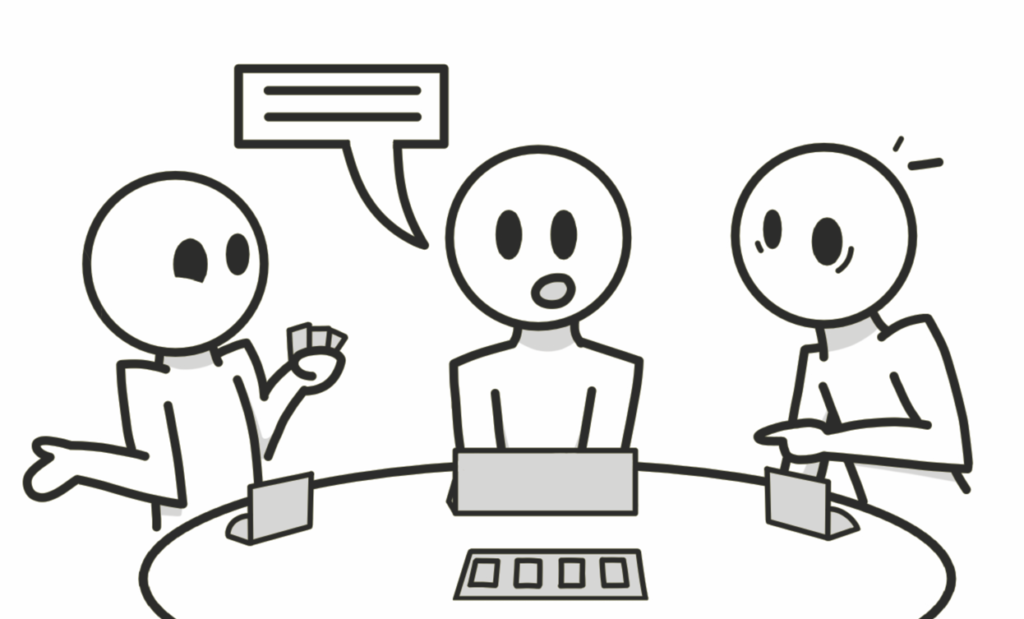
When team players think they’ve matched the correct sequence, everyone places their hands on their heads to indicate they’re ready.
If the sequence is correct, everyone moves onto round 2.
The game is played again with the same code phrases, and a new sequence to guess, except now there’s a time limit.
If the sequence is guessed correctly before time runs out, all players win.
By the end of my first semester, I had a game dummy with all necessary cards, pieces, and instructions on how to play under the name “Idioms”. Now I just needed to create a new theme, redesign everything for that theme, and find a way to display it all in an art gallery.
Even putting aside the gallery installation part, I do not recommend creating your own game on this timeline.
With the core gameplay itself figured out, the theme and design were a whole other challenge, which I can detail further in a future post.
For now, I hope this gives you a new perspective on board games, or maybe even inspires you to try making one yourself. It’s been an incredibly rewarding experience, and a creative process I’m very proud of.
So proud of you the time energy and perseverance payed off love you
WOW! All the work you must have put into this is astounding! Just so you know, my Dad liked to invent games too!