
We all know classic board games, Monopoly, The Game of Life, games you’ve played at family functions and probably continue to play a few too many times.
In my (admittedly biased) opinion, they’re old and overplayed at times. However, it’s not uncommon for new games to take inspiration from older ones, tweaking the mechanics or recreating a similar feeling.
Inspired by ProZD’s “10 Classic Board Games That Suck (And 10 to Replace Them),” I’ve compiled 3 board games I prefer over similar classics.
1. Tapple, instead of Scattergories
If you haven’t played Scattergories (by Milton Bradley), everyone starts with a list of categories, listing things like “a food,” “an animal,” and so on.
A die is rolled to pick a letter (like “B”), and everyone has a limited amount of time to write a word for each category starting with that letter.
After time runs out, points are awarded for unique answers.
I enjoy Scattergories, but it can definitely be improved.
Most of the game is just silently writing. You don’t want to give away your answers, and with limited time, the game ends up feeling very individual.
A great alternative is Tapple by The Op Games.
Tapple plays very similarly, but instead of individual writing, all players sit around a ring of letter keys. A category is picked from a card, and each player has 10 seconds to think of a word in that category starting with an unused letter.
On their turn, the player says a word, presses down the letter key, and resets the timer for the next player.
If time runs out, that player is out. The last player standing wins.
Tapple functions much more socially than Scattergories. Everyone gets to panic together and share the experience.
Personally, I’ve had way more laughs and fun with Tapple, whereas Scattergories sometimes feels like timed test taking, with less reaction to the answers when revealed.
2. Monikers, instead of Catch Phrase
Catch Phrase is a quirky game device created by Hasbro. It’s simple, two teams take turns, and one player holds the device. Phrases or words appear on screen, and the goal is to get your team to guess the word correctly.
You can use any description or gestures, just not the actual word, rhyming hints, or parts of the word. Each round is 90 seconds, and play rotates between teams.
Catch Phrase is fun, but it doesn’t compete with my favorite, Monikers.
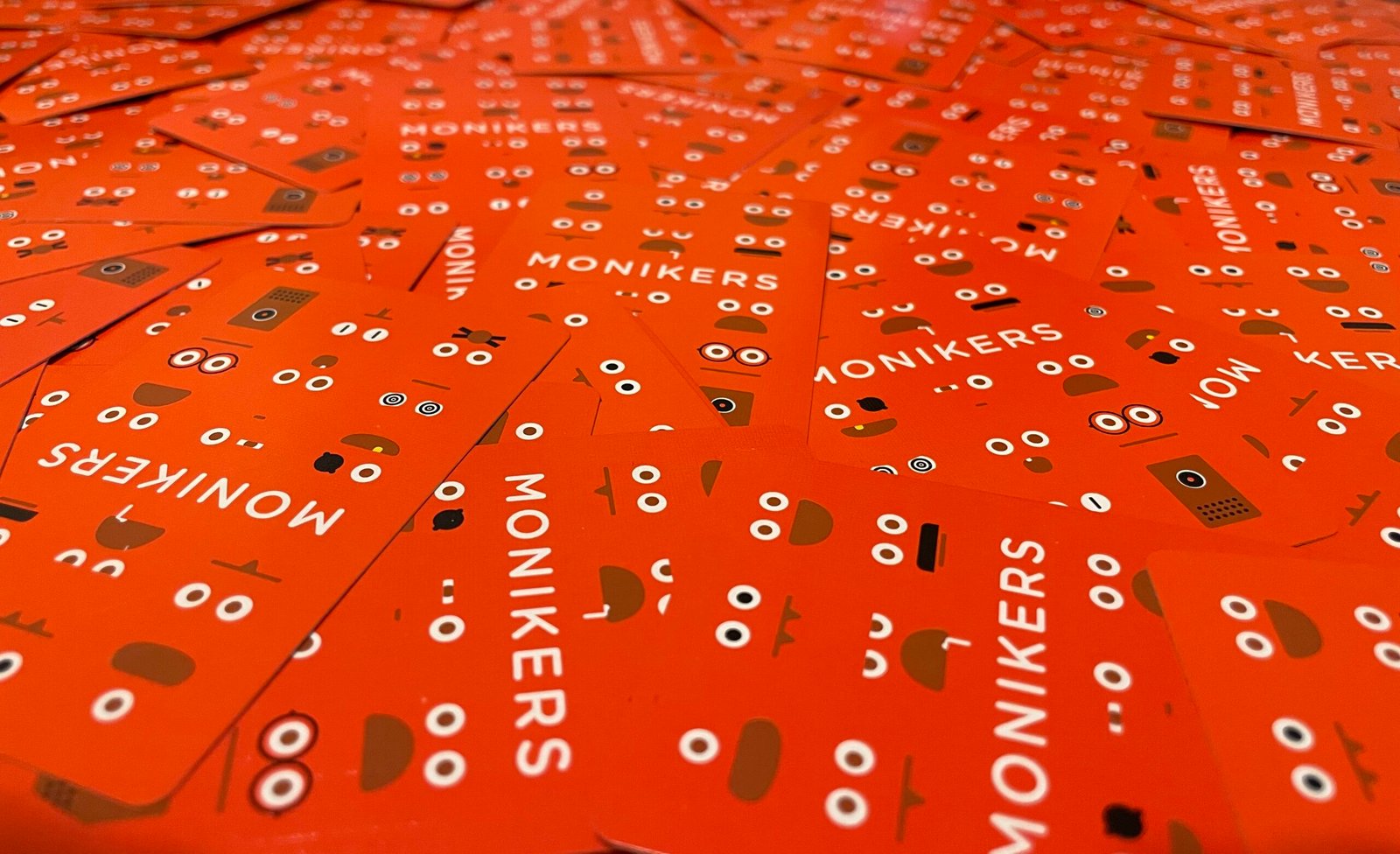
Monikers by CMYK Games is also played in two teams. Before the game begins, each player chooses cards to add to the deck.
The game is played in three rounds, with each team taking turns. Like Catch Phrase, the player must get teammates to guess the full word or phrase on the card without using those words.
Each turn lasts 60 seconds, and you earn points for every card guessed.
At the end of each round, points are tallied and the deck is shuffled and reused.
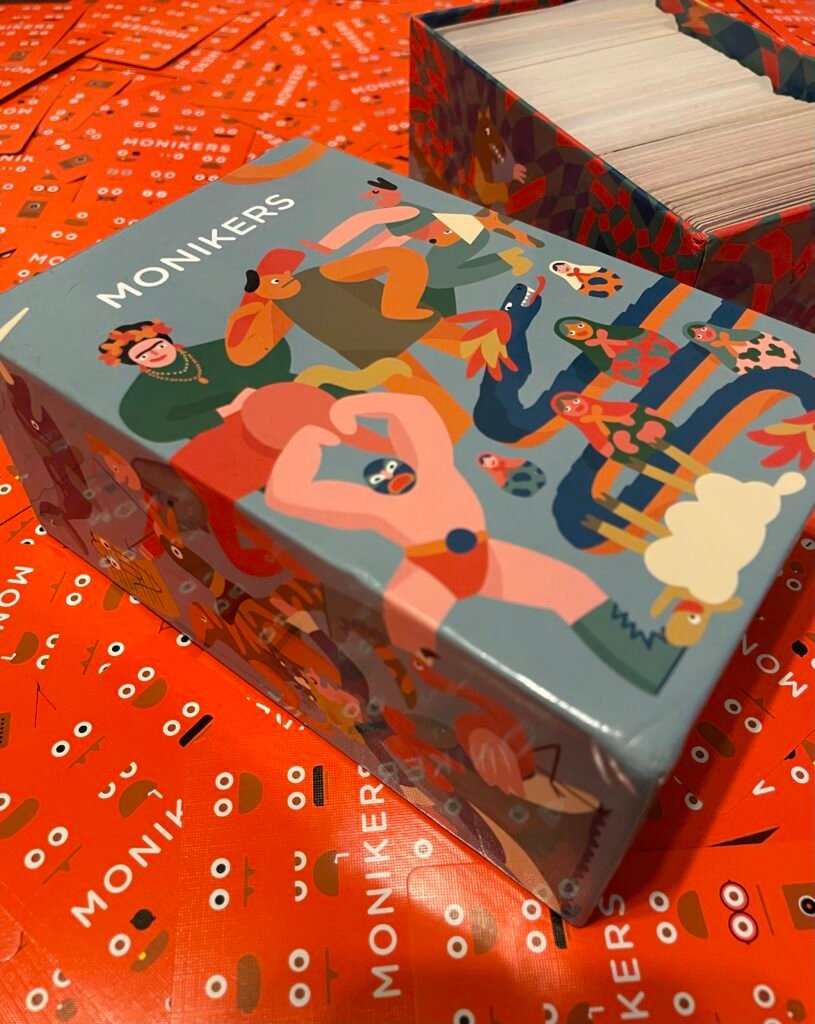
For round 1, card descriptions must be given verbally, talk as much as you want! For round 2, the description must be only one word per card, and round 3 is just charades.
It might sound like a lot, but the gameplay is incredibly well designed. For starters, you get to choose cards that go into the deck. Everyone starts with this little advantage, and the deck builds around the group you play with.
Monikers also rewards memory and recognition. In Catch Phrase, if it’s not your turn, there’s no gameplay incentive to pay close attention. In Monikers, it’s the opposite, especially as the rounds get harder.
The card content also varies wildly. One might say “Gluten,” while another says, “Pushing a hoop down a dirt path with a stick” (yes, this is a real card, yes you have to say the whole thing).
I’ve had a ton of fun with this game. It’s hilarious, rewarding, and I haven’t met anyone who doesn’t love it.
One thing to note however, the game is definitely geared toward teens and young adults. Many cards are memes or NSFW. You can filter these out, but I haven’t played it with much older or younger audiences, which could be a challenge.
3. Spots, instead of Yahtzee
Yahtzee, from Hasbro is a classic game where players try to get specific dice combinations each turn. You roll three times, choosing to hold or re-roll dice to aim for the best scoring combo. The goal is to strategically fill your score sheet and earn the most points.
If Yahtzee feels a bit old or repetitive, Spots offers a fresh twist.
Spots, also by CMYK Games, is a dice game about covering dogs in spots.
Each player has dog cards with blank spaces. On your turn, you pick a trick (which gives you a special ability) and roll dice to try and match up with your dog cards’ empty spots.
Dice that match can be placed. Dice that don’t get placed go to the “yard.” Complete a dog by filling in all its spots, and it goes to your completed pile.
You can keep rolling to try to do more, but if your yard exceeds 7, you bust and lose all progress that turn. The first player to complete 6 dogs wins.
The game adds versatility with treat tokens you can use to reroll, and various trick cards that offer new strategies each round.
My favorite part by far though, is the theme and art. The dog concept works perfectly with the game. In collaboration with artist Jon Perry, Spots features charming illustrations and adorable dogs!
So there you have it, 3 games I much prefer over their classic counterparts.
Board games are constantly evolving, borrowing ideas and mechanics from one another. That’s what makes games so exciting.
You get a world of innovative, interesting new games that stand on their own, while still paying tribute to the classics.
I hope this encouraged you to give some of them a try, especially if you enjoy the mechanics present in the originals.